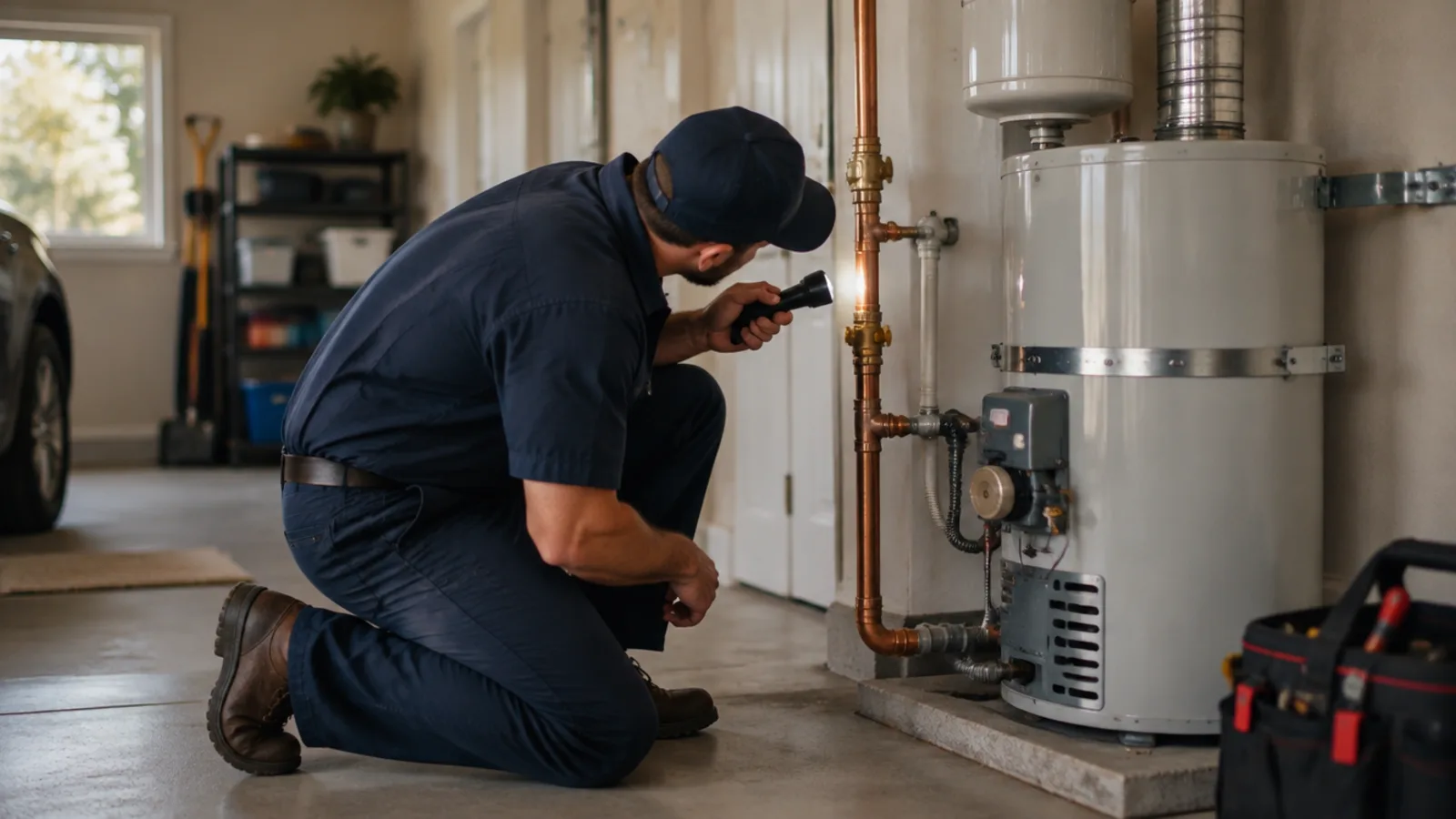
The pilot that will not stay lit
On a standing-pilot heater, a small flame burns all the time at the burner. A thermocouple sits in that flame. It is a thin copper lead with a probe on the end. While the flame heats it, it makes a tiny current that holds the gas valve open. Take the flame away and the valve closes. That is a safety device doing its job.
A failing thermocouple looks like this. The pilot lights. You hold the button down for as long as the instructions say. You let go, and the flame drops out within a few seconds. The gas valve is not getting the signal to stay open. Either the thermocouple has worn out or the pilot flame is not wrapping around the probe properly.
A weak pilot does the same thing. A pilot flame should be steady and blue and cover the top of the probe. A small, lazy or yellow pilot usually means a dirty pilot orifice or a bent pilot tube, and the thermocouple never gets hot enough. Replacing the thermocouple on a heater with a weak pilot fixes nothing.
A pilot that will not light at all points further back: the gas supply, the supply valve, or the gas control itself. Newer heaters with electronic ignition have an igniter and a flame sensor instead of a thermocouple, but the logic is the same. Either it lights and drops out, or it never lights.
A pilot that lights and drops out the moment you let go of the button is the thermocouple or the pilot flame. A pilot that will not light at all is further upstream.
The thermal switch, and why lint matters
Most gas tanks built in the last couple of decades have a sealed combustion chamber. Air gets in at the bottom through a flame arrestor. That is a screen or perforated plate that stops fumes from a spilled can of gasoline from reaching the burner. Next to it is a thermal switch. If the chamber runs too hot, the switch cuts the gas.
The usual reason it runs too hot is that the burner cannot breathe. Water heaters live in garages and laundry closets, and a heater next to a dryer pulls lint into that screen every day. Dust, pet hair and cobwebs do the same. As the screen clogs, the burner gets less air and the flame rolls out toward the opening. The chamber overheats and the switch trips.
On some models the thermal switch resets. On many it is a one-time part that has to be replaced once it trips. Either way, the switch is not the fault. If a heater trips its thermal switch, gets relit and trips again, it is telling you the air supply is blocked or the burner has a problem. The fix is cleaning the arrestor and the burner and finding out why the air ran short.
What you can do is keep the area around the bottom of the heater clear. Do not store laundry, boxes or cleaning supplies against it. Do not try to clean the arrestor screen through the burner opening yourself.
A gas control that has stopped responding, and a yellow burner
The gas control is the box on the front of the tank with the dial and the pilot button. It holds the thermostat and the valves that feed the pilot and the main burner. Say the pilot is lit and steady, the thermocouple is good and the dial is turned up, but the main burner never comes on. The control is the likely answer. Controls do fail. A failed control is still just a part, and on its own it is no reason to replace the tank.
A burner should burn blue, with steady flames and maybe a little orange flicker at the tips. A burner that burns yellow, lazy and tall, or leaves soot, is not getting enough air or is getting the wrong gas mix. A yellow flame means incomplete combustion. It makes soot and it makes carbon monoxide.
You may see the result before you see the flame. Black soot on the burner door, around the draft hood on top of the tank, or on the wall or ceiling near the vent. A burning or exhaust smell in the room when the heater runs. Headaches or nausea in the household that ease when people leave the house.
None of that is a hot water problem. Turn the gas control to off, open a window, and call. If anyone feels unwell, get them outside and call emergency services before you call a plumber.
The one relight attempt, and the hard stop
Every gas tank has lighting instructions on a label on the jacket, usually near the gas control. If the label is there and readable, you can make one relight attempt by following it exactly. Not the instructions for a different heater, and not a video. The label on your tank.
Those instructions start with turning the control off and waiting for any gas to clear before you light anything. Do not skip that wait. If you smell gas at any point, stop. Do not touch any switch. Leave the house and call the gas utility from outside.
If the pilot lights, stays lit and the burner comes on, watch it. A steady blue flame and hot water coming back means it may hold. The pilot still went out for a reason, so mention it when you call. If the pilot will not light, lights and drops out, or the burner lights yellow, you have your answer. Leave the control off and call. Do not keep cycling the button trying to make it hold.
The hard stop is any of these: a gas smell, soot around the draft hood or the burner door, or a thermal switch or pilot that keeps going out after a relight. Any of those means leave the heater off, open a window, and call. If exhaust is spilling back into the room instead of going up the flue, that is carbon monoxide in the house. A working pilot does not make it safe.
One relight by the label on the tank. If it does not hold, or you see soot or smell gas, it stays off.
Cheap fix, or the end of the heater
A thermocouple, a pilot assembly, a thermal switch, an igniter, a gas control valve. These are all parts. On a heater that is otherwise sound, replacing one is a normal repair, and it is usually the right call.
The tank is the thing that cannot be fixed. Water coming from under the jacket with every fitting dry, rust streaking from a seam, or rusty water on the hot side only all mean the lining has failed. No burner part changes that. A gas tank heater commonly lasts roughly eight to twelve years. That is a general range for the appliance. We would need to see your heater and its data plate to say anything about yours.
The judgment call is a heater near the end of that range with a part failing. A new gas control on a tank that is starting to weep is money spent on the part that was not going to fail next. Once we have looked at it, we will tell you which of those two situations we think you are in.
We do not name a number before seeing the heater, and we will not diagnose it over the phone. Gas water heater work is done by Pipe Perfect LLC, a Florida Certified Plumbing Contractor, license CFC1431903. Where the work requires a permit, it is permitted and inspected under that license.