Three places to shut the water off
A Florida slab house usually has water shutoffs in three places, and which one you reach for depends on what failed and how fast you need it closed. None of them require you to go near the fixture that is leaking.
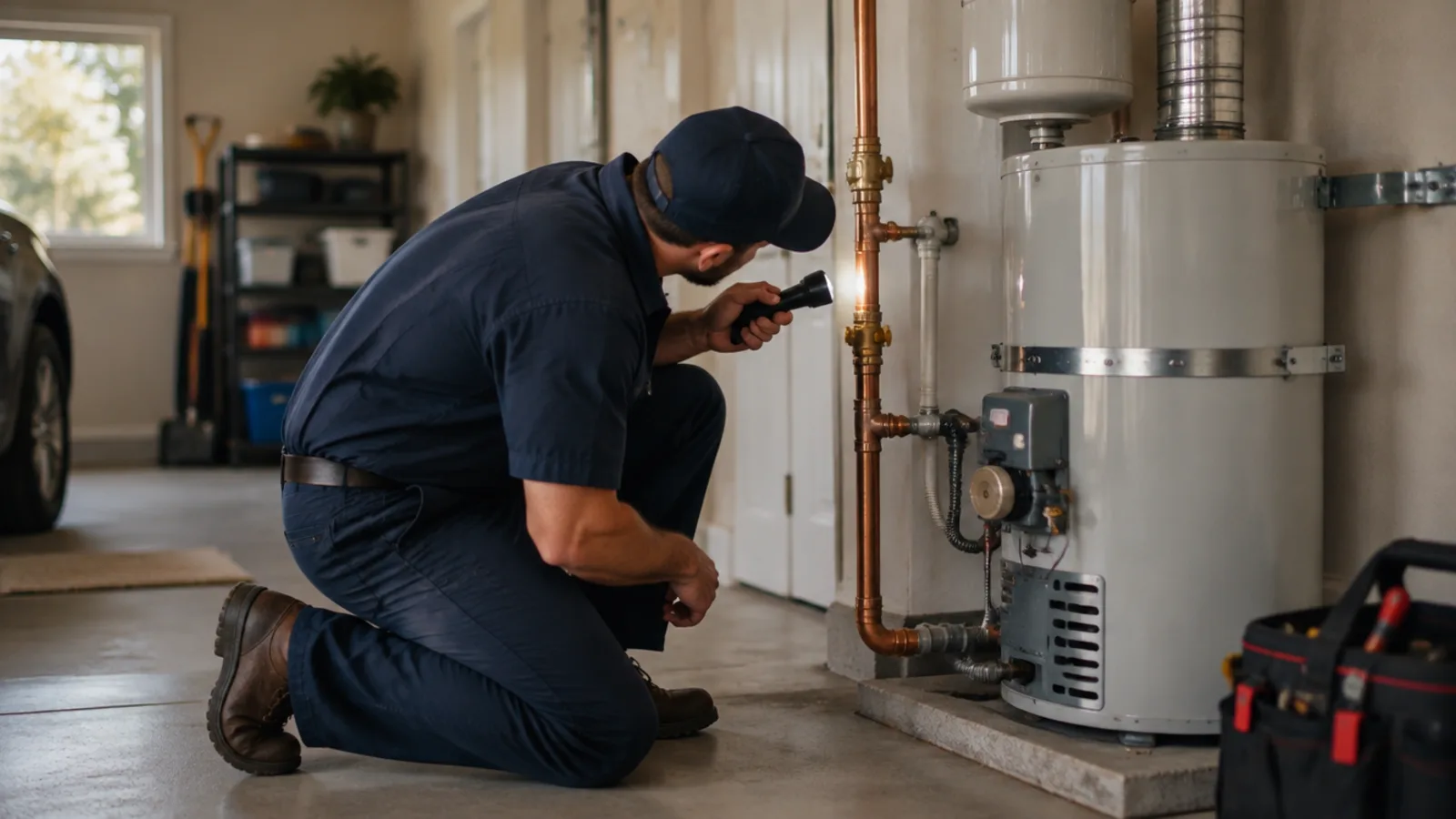
The fastest is usually an interior valve near the water heater or the laundry, where the main supply line comes up out of the slab before it branches out to the rest of the house. On a lot of houses this is the only indoor shutoff for the whole water supply, so it is worth knowing on sight rather than hunting for it with a flashlight.
The second is an exterior wall valve, typically set at roughly hose-bib height on the side of the house closest to the street or the meter. This is where the supply line enters the house before it goes under the slab, and on houses without an interior main valve, this is the one that does the job.
The third is the meter box, a lid at ground level near the sidewalk or the property line, usually concrete or plastic and often half full of sand. Inside sits the meter and, on the street side of it, the curb stop — the valve that belongs to the house rather than the utility. It takes a meter key, a long-handled tool made for the job, though a crescent wrench will sometimes reach it. This valve works even if every other valve in the house has failed, because it is upstream of all of them.
Gate valve or ball valve, and which way closes it
Before you touch a valve in an emergency, you need to know in half a second which kind you are looking at, because they close in different ways and one of them does not announce when it has finished closing.
A ball valve has a lever handle, usually the same diameter as the pipe. It is fully open when the lever lines up with the pipe and fully closed with a single quarter turn, so the lever sits across the pipe instead of along it. There is no guessing — it stops hard at both ends.
A gate valve has a round handle, like a small steering wheel, and a flat gate inside that rises and falls across the pipe. It closes clockwise, the same direction as tightening most things, and it takes several full turns, not one. Older houses and the valve in the meter box are more likely to be gate valves.
The trouble with a gate valve is that it can turn without actually sealing. The gate can bind partway down, or the stem can strip, and the handle will keep turning after the valve has stopped doing anything. If you close one and water is still moving at a fixture, do not assume you did it wrong — assume the valve has failed, and go to the next shutoff upstream of it.
A ball valve tells you when it is closed. A gate valve will sometimes keep turning long after it has stopped sealing.
Exercise the stiff valve now, not during a flood
A valve that has not moved in ten years is not a working valve, it is a decoration. Minerals in Pasco County's water settle on the stem and the seat, rubber washers in older gate valves take a set and stop sealing fully, and a valve left alone long enough can seize so hard that forcing it snaps the handle off in your hand.
Close every shutoff in the house once or twice a year and open it back up. That includes the main, the exterior wall valve, the meter box valve if you can reach it safely, and the stop valves under sinks and behind toilets. Turning it while nothing is wrong is how you find out it is stiff, weeping at the stem, or will not fully close, while you still have the luxury of fixing it on a weekday.
If a valve groans, will not turn past a certain point, or starts dripping around the handle the moment you move it, that valve needs replacing before it needs using. A shutoff you cannot close in an emergency is the same as not having one, and the five minutes it takes to exercise a valve costs nothing compared to what a stuck one costs later.
Fixture shutoffs: toilets, sinks, and the water heater
Most leaks do not need the whole house shut off, and closing a fixture-level valve is faster than walking to the meter box. Every toilet has an oval or round handle on a small valve low on the wall or floor behind it, on the supply line feeding the tank. Closing it — usually clockwise — stops a running fill valve or a cracked tank without touching anything else in the house.
Sinks have the same kind of stop valve under the basin, one on the hot line and one on the cold, feeding the faucet. A supply line that has split under a sink is a job for those two valves, not the main. They see even less use than the main shutoff and are just as prone to seizing, which is another reason to turn them once or twice a year.
The water heater has its own shutoff on the cold inlet line, where water enters the top of the tank, usually a valve with a round handle or a lever. Closing it stops new water from entering a tank that is leaking, which is most of what stops the leak from getting worse while you sort out the cause. It does not drain the tank — that is a separate step and not something you need to do in the first few minutes.
After the water is off: power, pressure, and the meter-dial test
Once the water is stopped, kill the power. An electric water heater left energized while it drains can burn out an element, and a well pump that keeps running with no water to move will run dry and damage itself within minutes. Find the breaker for each at the panel — labeling them now, before anything goes wrong, saves you from reading labels by flashlight later.
Open the lowest tap in the house, inside or out, once the main is closed. Water is still sitting in the pipes under pressure even after the supply stops, and that pressure is what keeps pushing water out through whatever failed. Draining it from the lowest point — a laundry tub, an outside hose bib, a ground-floor sink — relieves that pressure through a fixture instead of through the leak.
To confirm whether water is still running anywhere in the house, use the meter. Shut off every fixture and appliance that uses water, then find the small triangle or dial on the face of the meter — it is there specifically to register flow too small to notice anywhere else. If it is turning with everything off, water is moving somewhere in the house whether you can see it or not, and that points to a fixture valve that did not fully close or a leak you have not found yet, not a problem with the main.
If the dial is still, you have genuinely stopped the water, and whatever you are looking at on the floor is what was already out before you closed the valve. That is the point where it is worth a call, not before — tell us which valve you closed and what the meter did, and we will know what we are coming to find.