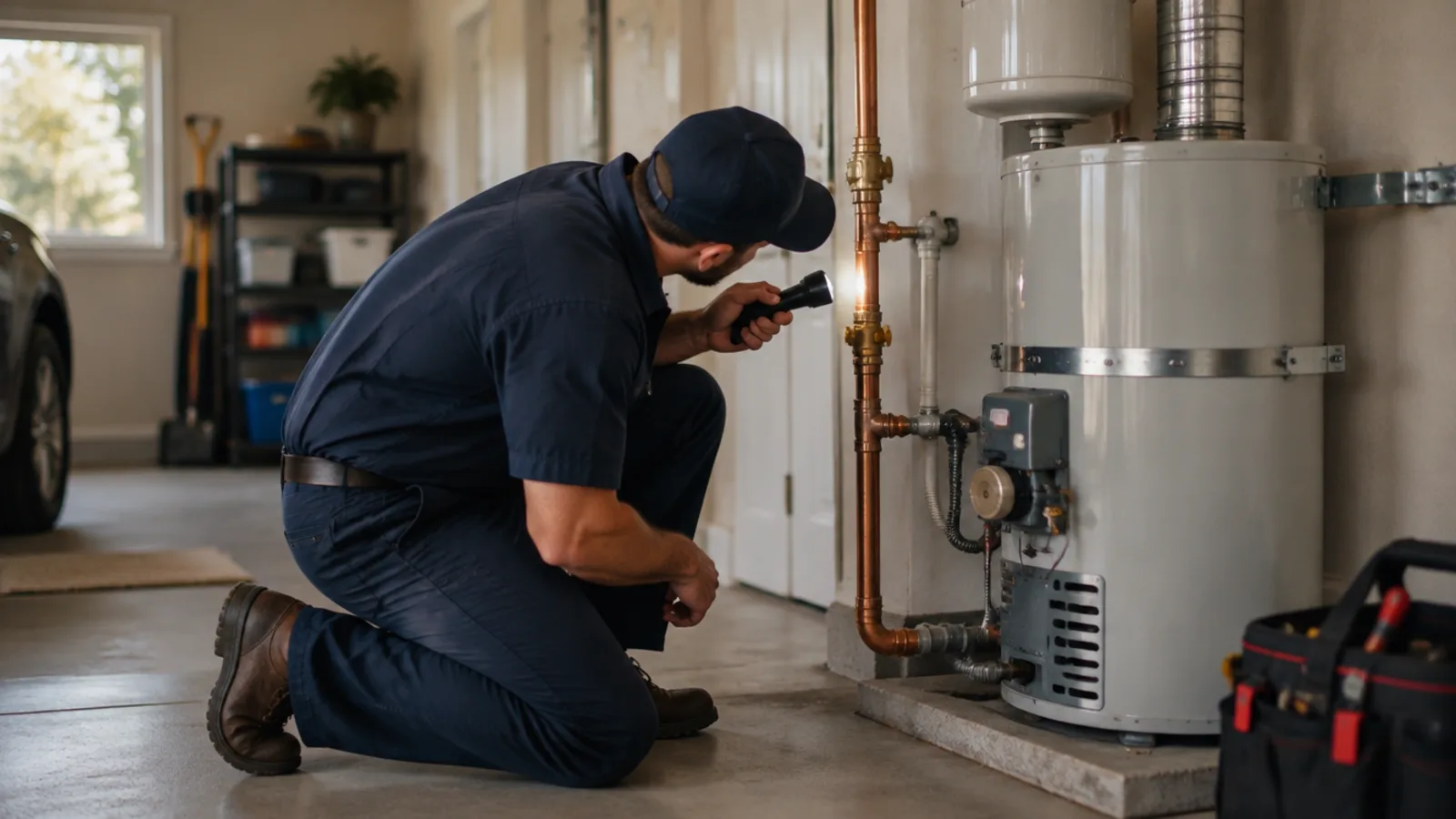
What a slab leak actually is
Most Florida houses are built on a concrete slab poured on grade, with the water supply lines run underneath it or cast into it. There is no crawl space. When one of those lines fails, the water has concrete above it and sand below it, and it goes wherever it can.
That is the whole reason the signs are strange. A leak in a wall shows you a wet wall. A leak under a slab shows you a warm floor in the kitchen while the actual break is under a bedroom fifteen feet away.
Two things usually fail. Copper supply lines corrode from the outside in, and the failure is often a pinhole that weeps for months rather than a burst. Polybutylene, which went into a lot of Florida homes before the mid-nineties, fails at the fittings and along the pipe itself.
The other thing worth knowing is that a hot-water line leaks differently from a cold one. Hot lines give you more to work with, because heat travels through concrete and cold water does not.
The signs, in the order people notice them
A warm spot on the floor. Walk the house barefoot on tile or vinyl with the air on. A patch that is noticeably warmer than the floor around it, in a spot with no sun on it and no appliance near it, is a hot-water line running under the slab. This is the most specific sign there is and it is the one people most often shrug off.
The sound of running water when every fixture is off. Stand in a quiet room late at night and listen. A faint continuous hiss or trickle with nothing running is water escaping under pressure.
A water bill that climbed with no change in the household. Nobody moved in, nothing broke that you can see, and the bill went up and stayed up. This is often the only sign for a couple of billing cycles.
Hot water that never quite gets hot, or a water heater that runs more than it used to. A leaking hot line bleeds heated water into the ground continuously, so the heater keeps firing to replace it.
Low pressure at every fixture at once, rather than at one tap.
A warm patch of floor in a room with nothing warm in it is not a quirk of the house. It is a hot-water line running under the concrete.
The later signs, once it has been running a while
Cracks. A leak washing sand out from under a slab takes away the support the concrete was poured on, and the slab moves. That shows up as cracks in tile grout, cracks in drywall above door frames, doors that stop latching, or a crack across a garage floor or driveway. Not every crack in a Florida house is a leak — slabs crack for other reasons — but a new crack that appears alongside any of the earlier signs is worth taking seriously.
A floor that feels uneven, or tile that sounds hollow when you tap it.
A musty smell with no visible source, or mold appearing along a baseboard. Water that has been under the slab for months comes up through the concrete as vapor.
Damp or discolored carpet, or flooring that lifts or buckles in one area.
We cannot tell you which of these is structural and which is cosmetic. That is not our trade. What we can do is find out whether water is moving under your slab, which is the question underneath all of it.
Slab or yard: how to tell them apart
This is the one distinction that changes what happens next, and you can settle it yourself in an afternoon with the meter.
Turn off every fixture and appliance that uses water. Ice makers and irrigation timers catch people out here, because both run on their own and will ruin the test. Read the meter, including the small sweep hand or leak triangle. Wait an hour with nothing running and read it again. If it moved, water is going somewhere.
Now shut the valve where the supply enters the house and repeat. If the meter still moves with the house isolated, the leak is between the meter and the house — the yard, the service line. If it stops moving, the leak is on the house side, which on a slab-on-grade home usually means under the concrete.
The signs differ too. A yard leak gives you a patch of grass that stays greener, softer or taller than everything around it through a dry stretch, or standing water with no rain. A slab leak gives you the indoor signs above and often nothing at all outside. A yard leak also cannot give you a warm floor.
What happens when we come out
We locate before we open anything. Acoustic listening equipment picks up pressurized water escaping through concrete, which you cannot hear with an ear on the floor. A pressure test on the hot and cold lines separately tells us which side has failed. Thermal imaging finds a hot-water leak by the heat plume it leaves in the slab. Where acoustics will not work, tracer gas will.
All of that is non-destructive. The point of it is to open the floor in one place instead of four, because the concrete work is the expensive part of a slab leak, not the pipe.
From there the repair is usually one of three things: open the slab at the break and fix it, reroute that line overhead or through the walls to bypass the slab entirely, or repipe the house if the pipe that failed is the same age and material as everything else in it. Which one makes sense depends on what we find, how many failures the house has already had, and what is under the floor. We will tell you after we have looked, not before.
Photograph everything before anyone touches it, dated — the meter reading, the warm patch, the cracking, the bill. If this becomes an insurance conversation, that is the record you want. What your carrier decides is between you and them, and we do not know what your policy says.