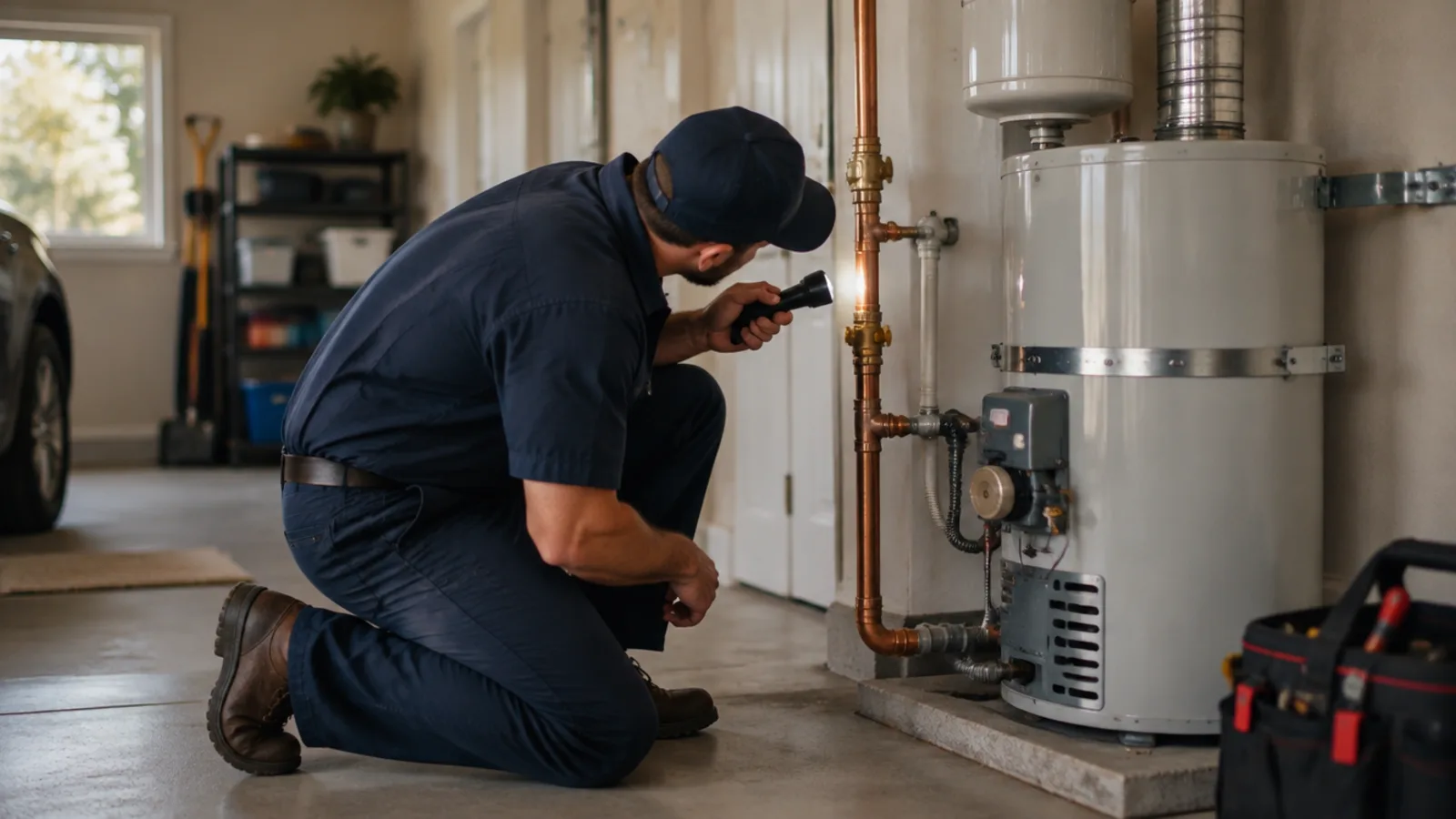
Water at the base tells you there is a leak, not what failed
Water collects at the bottom of a water heater whatever leaked above it, because that is the lowest point on the unit. The puddle does not point at the tank by itself. Several things sit on or around a tank that can fail and send water to the floor, and only one of them means the heater is finished.
The four repairable sources are a temperature and pressure relief valve weeping from the overflow pipe, a drain valve that has loosened or is seeping at its own threads, condensation forming on a cold fitting, and a failed supply connector at the cold inlet or hot outlet. Any of those can be fixed without replacing the tank.
The one that is not repairable is a tank that has rusted through, usually along a welded seam near the bottom. That water is often rusty or discolored, because it is carrying the inside of the tank with it.
Dry the area completely, including the fittings above it, and watch where water reappears first. That single check does more to sort these apart than anything else.
The puddle tells you there is a leak. It does not tell you what failed — dry everything and watch where the water comes back first.
The leaks that are a fifteen-minute fix
A weeping relief valve. The temperature and pressure relief valve sits near the top of the tank with a pipe running down to near the floor, and it is there to open if pressure or temperature inside the tank gets too high. A valve that drips steadily from the end of that pipe is often doing its job — venting pressure the system is building somewhere else, commonly a failing thermal expansion tank or a water heater thermostat set too high. Sometimes the valve itself has just gone bad and needs replacing. Either way it is a part, not the tank.
A loose or seeping drain valve. The drain valve near the bottom of the tank gets used once a year if that, and the plastic ones common on residential tanks weep at the threads once they age or if they were overtightened. Tightening it, or swapping it for a proper valve, usually stops it outright.
Condensation on a cold fitting. In a humid Florida garage or closet, the cold-water inlet pipe can run cooler than the air around it, especially right after the tank refills with cold water. Moisture beads on the pipe and fitting and drips down, and it looks exactly like a leak from above. It tends to show up on hot, humid days and dry up when the air conditioning runs, which a real leak does not do.
A failed supply connector. The flexible connector or compression fitting at the cold inlet or hot outlet corrodes or works loose over time, particularly on the galvanized nipples some older tanks still have. Replacing the connector or fitting is a straightforward repair.
The one leak that is not a repair
A water heater tank is a welded steel vessel with a thin glass lining fired onto the inside to keep the steel from contacting water directly. Once that lining cracks or wears through, usually after years of heating and hard-water mineral buildup, heated water starts corroding bare steel from the inside. The weld seams, where the lining is thinnest to begin with, go first.
By the time rust-colored water is visible on the outside of the tank, the steel around that spot has been thinning for a long time, and there is no sound metal left to patch to. No valve, connector, or sealant changes that. The tank needs replacing.
Rusty water, a stain that keeps coming back in the same spot no matter how often it is dried, or water that smells metallic are the signs that point here rather than at a fitting. A standard tank water heater generally runs eight to twelve years and a tankless unit commonly fifteen to twenty — those are general service-life ranges for the appliance, not a reading on any one installation, and we would need to see the unit and its data plate to say anything about yours.
What to do first
Shut the cold inlet valve. It is on the pipe feeding the top of the tank, usually with a round handle or a lever. Closing it stops new water from entering the tank, which is what is pushing water out through whatever failed.
Kill the power or the gas. On an electric heater, switch off the breaker — do not let an element keep heating a tank that is losing water, since an element firing with too little water around it can burn out or worse. On a gas heater, turn the gas control knob to off or close the gas shutoff valve on the line. Do not leave a burner running near a floor that is wet.
Move anything stored on the floor nearby. Cardboard, stored paint, anything that holds water or draws it by wicking should come off the floor immediately, before the leak gets worse or spreads further than it already has.
After that, the inlet is closed and the heater is off, which buys time to work out which of the leaks above you actually have — and whether it is a part or the tank.
Why the pan and its drain line matter here, and what shortens a tank's life
Most houses in this area are built slab-on-grade, with no basement to absorb a slow leak and buy time before anyone notices. A water heater commonly sits in a garage, a closet off a hallway, or an attic, often with finished flooring or drywall right next to or below it. A drain pan under the tank catches a leak before it reaches that flooring, but only if the pan itself has somewhere to send the water — a line routed to a floor drain, to the outside, or to a safe termination point. A pan with no line just delays the overflow until the pan fills, which on a slow leak can still take long enough to do real damage to a floor it was supposed to protect.
Inside the tank, a sacrificial anode rod is what keeps the steel from corroding first — it is designed to corrode away in place of the tank wall. Once the rod is consumed, the tank starts corroding instead, and that is when seams start failing. Pasco County generally runs hard water, and the dissolved minerals in hard water both use up an anode rod faster and settle as sediment on the tank bottom, which traps heat against the lower part of the tank and accelerates the same corrosion from the inside.
None of that is a reason to delay checking a current leak. It is the reason a tank with no serviced anode rod and years of hard water behind it is a more likely candidate for 'the tank is going' than a newer one, once rusty water or a seam leak rules the simple fixes out.