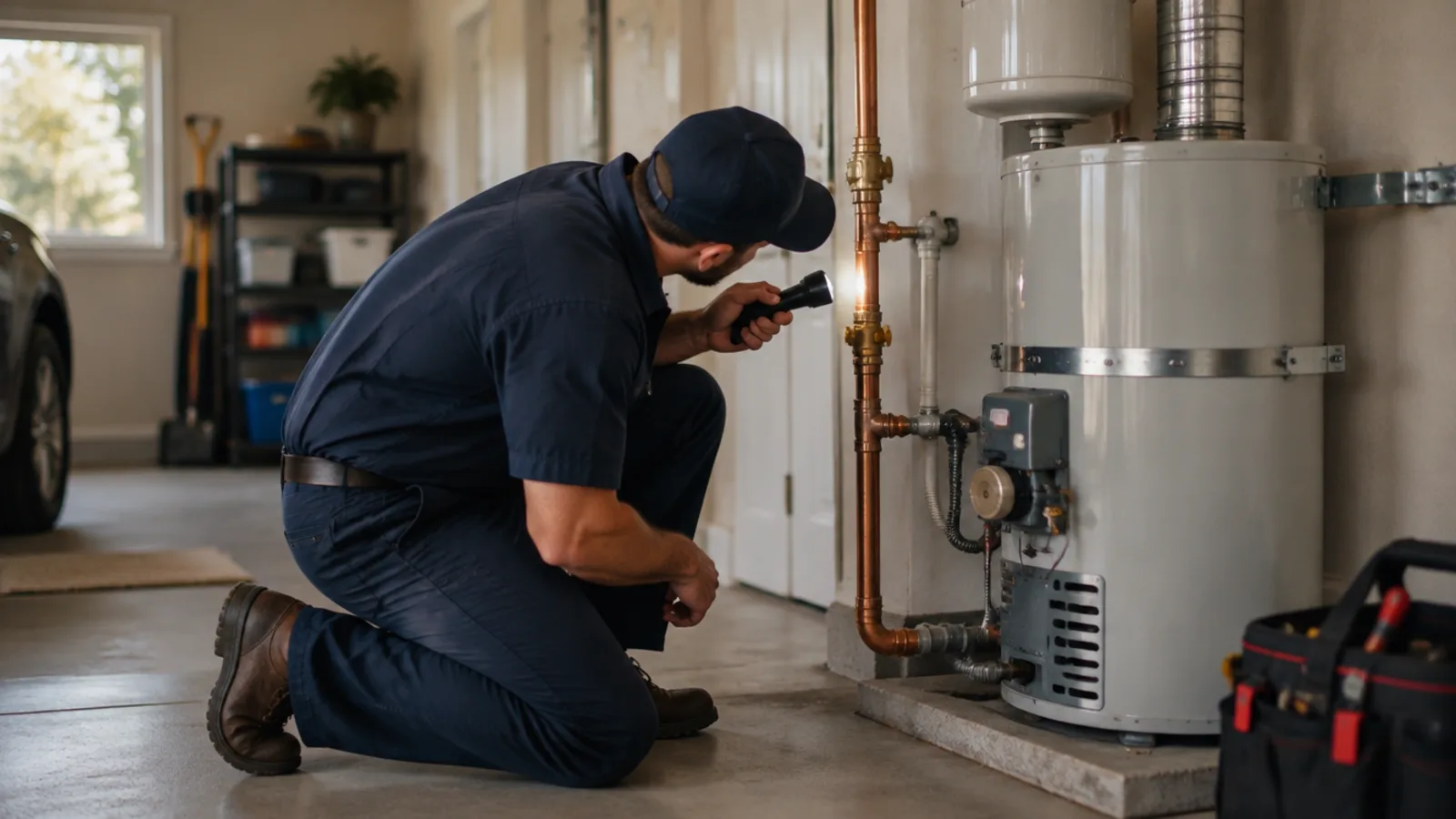
Start by finding out where the water is coming from
Almost every repair-or-replace decision on a water heater comes down to this one question, and most people answer it wrong because they see water on the floor and assume the tank is gone.
Dry the area completely, put paper towel down, and look again in a few hours. Then trace upward. Water runs down and pools at the base no matter where it started, so the base is where it collects, not where it came from.
Check the cold inlet and hot outlet fittings on top, the temperature and pressure relief valve and its discharge pipe, the drain valve at the bottom, and the pan fitting. All of those are serviceable parts. A loose or corroded fitting, a dripping drain valve, a relief valve that has started to pass — none of those is a reason to replace an appliance.
If the fittings are dry and the water is appearing from under the jacket, or there are rust streaks running down the shell from a seam, that is the tank. That one is not a repair. We cover why below.
Water pools at the base of every water heater that leaks, whatever the cause. The base tells you there is a leak. It does not tell you what failed.
The faults that are worth repairing
A thermostat. On an electric heater this is a small control strapped to the side of the tank behind an access panel, under insulation. When one fails you get water that is far too hot, far too cold, or that swings. It is a cheap part and a short job, and the tank is unaffected.
A heating element. Electric heaters have one or two elements screwed through the tank wall into the water. A burned-out upper element gives you no hot water at all; a burned-out lower one gives you a little hot water that runs out fast. Elements are replaceable with the tank in place. Note that an element that keeps burning out is usually telling you it is buried in sediment, which is a different problem on the same appliance.
A gas thermocouple, igniter or gas control valve. On a gas heater, a pilot that will not stay lit or a burner that will not fire is normally one of these, not the tank. These are serviceable.
A relief valve. If it drips or discharges, it gets replaced, and the pressure behind it gets investigated. What it never gets is capped. That valve is the only thing standing between a heated, closed vessel and a real failure.
A failed expansion tank, a bad dip tube, a leaking drain valve, loose or corroded supply connections, a tripping high-limit cutoff. All of these are parts attached to a tank that is still sound.
The reasonable test for any of these is the age of the tank. Putting a new element in a four-year-old heater is obvious. Putting one in a thirteen-year-old heater that has never been flushed buys you a repair on an appliance that is already past the range — we will say so, and the call is yours.
A leaking tank is never a repair
A tank water heater is a welded steel vessel with a thin glass lining fired onto the inside. The steel holds the pressure. The lining is the only thing keeping heated water off the steel.
Once that lining fails anywhere, the water reaches bare steel and corrodes it from the inside. By the time it has eaten all the way through the wall and water is appearing on the outside, the metal around that spot is already thin across a wide area. There is nothing solid to weld or patch to.
So there is no repair. Welding a pressure vessel that is corroding from the inside is not a thing anybody does, patching compounds do not hold against heated water under line pressure, and a tank that has opened in one place has been thinning everywhere for years. Any trade that tells you otherwise is not going to be there when it lets go.
The signs that it is the tank and not a fitting: rust-colored water on the hot side only, with the cold running clear; rust weeping or streaking down the shell from a welded seam; staining in the pan that comes back after you dry it; or water appearing from beneath the outer jacket with every visible fitting dry.
A tank that is weeping today is doing a small version of what it will eventually do all at once. Forty, fifty or eighty gallons hits the floor, and the cold supply keeps feeding it until somebody closes a valve.
There is no patch for a corroded tank. By the time water shows on the outside, the steel around it has been thinning for years.
Sediment and the anode rod: the two things that decide how long you had
Most of this county runs hard water. Every time it is heated, dissolved calcium and magnesium drop out of solution, and in a tank they settle to the bottom as sediment.
That layer does real damage. It insulates the bottom of the tank from a gas burner, so the steel there runs hotter than it was designed to while the water above heats more slowly. On an electric heater, it buries the lower element so it fires inside a crust instead of in water. Rumbling, popping or a kettle sound when the heater runs is water boiling in pockets under that layer.
Flushing the tank annually is what removes it, and on hard water it is the single maintenance item that changes the outcome. A tank that has been flushed every year and a tank that has never been flushed are not the same appliance at year eight.
The anode rod is the other one. It is a sacrificial length of magnesium or aluminum threaded into the top of the tank, and it corrodes on purpose so that the steel does not. It is doing that job from the day the heater was installed. When it is consumed, the next thing to corrode is the tank lining and then the tank.
Almost nobody replaces one. It is a cheap part, it is checkable partway through the heater's life, and on hard water it goes faster than the label assumes. A heater that has had its rod replaced once has a materially better chance of reaching the top of its range than one that has not.
Neither of these is a repair for a tank that has already gone through. Flushing a heater that is weeping does not help it, and a new anode rod cannot restore a lining that is already breached. They are what you do while the tank is still sound.
How we decide, and what we tell you
We find the source of the leak first, because that answers most of the question on its own. Fitting, valve, connection or pan — serviceable. Tank — replaced.
Then the age off the data plate. Most manufacturers encode it in the serial number, usually in the first four characters: two digits for the week or month, two for the year. A standard tank heater runs about eight to twelve years and a tankless unit commonly fifteen to twenty, as general service-life ranges for the appliance. What the specific one in your garage has left is not something we will tell you over the phone.
Then whether the fault is the first one or the third. A heater that has had an element, then a thermostat, then a relief valve is telling you something that the individual parts do not.
Then whether the conditions that killed it are still in place. A replacement dropped into a system with no working thermal expansion control, on untreated hard water, with nobody flushing it, lands in the same spot as the last one. If we are replacing a heater, that gets discussed, because otherwise you are buying the same outcome again.
And where it sits. A heater in a garage on a slab that drains is a different risk from one in an interior closet over finished floor. That does not change whether a part is repairable, but it changes how much a failure costs you while you are deciding.
We do not name a number before looking at it. Whether any water damage is covered is between you and your carrier — policies commonly treat the failed appliance and the damage it caused as two separate things, and we do not know what yours says. Photograph everything, dated, before anyone starts pulling up flooring.
Pipe Perfect LLC is a Florida Certified Plumbing Contractor, licence CFC1431903. Replacement work is permitted and inspected under that licence. We are a plumbing contractor and nothing more — we do not perform or sign inspections that require a licence we do not hold.