The test: is water going where it should not be
There is one question underneath all of this. Is water, or sewage, currently entering your house or your walls in a place it does not belong, and can you stop it. If the answer is yes and no, that is an emergency and it does not matter what time it is.
Everything else is a judgment call about how much worse it gets overnight. A fixture that does not work is not putting water anywhere. A line that has split is putting water somewhere every second it stays open, and a slab or a wall cavity absorbs a lot of it before you see any of it.
The second question is whether anybody in the house is at risk. Sewage on the floor, the smell of gas near a gas water heater, water near an electrical panel or an outlet — those move a problem up the list regardless of volume.
Nothing here is about being brave with it. If you are not sure whether it can wait, call and describe what you are looking at. Telling you what you are dealing with over the phone costs you nothing, and we would rather talk to you at eleven at night than look at the floor in the morning.
What cannot wait until morning
A burst or split supply line. Water under pressure, no way to stop it at the fixture, and it keeps coming until a valve closes. This is the clearest emergency there is.
Sewage backing up into the house. Water coming up a floor drain, a shower pan or the lowest toilet means the main line is blocked and everything that goes down is coming back. That is a contamination problem as much as a water problem.
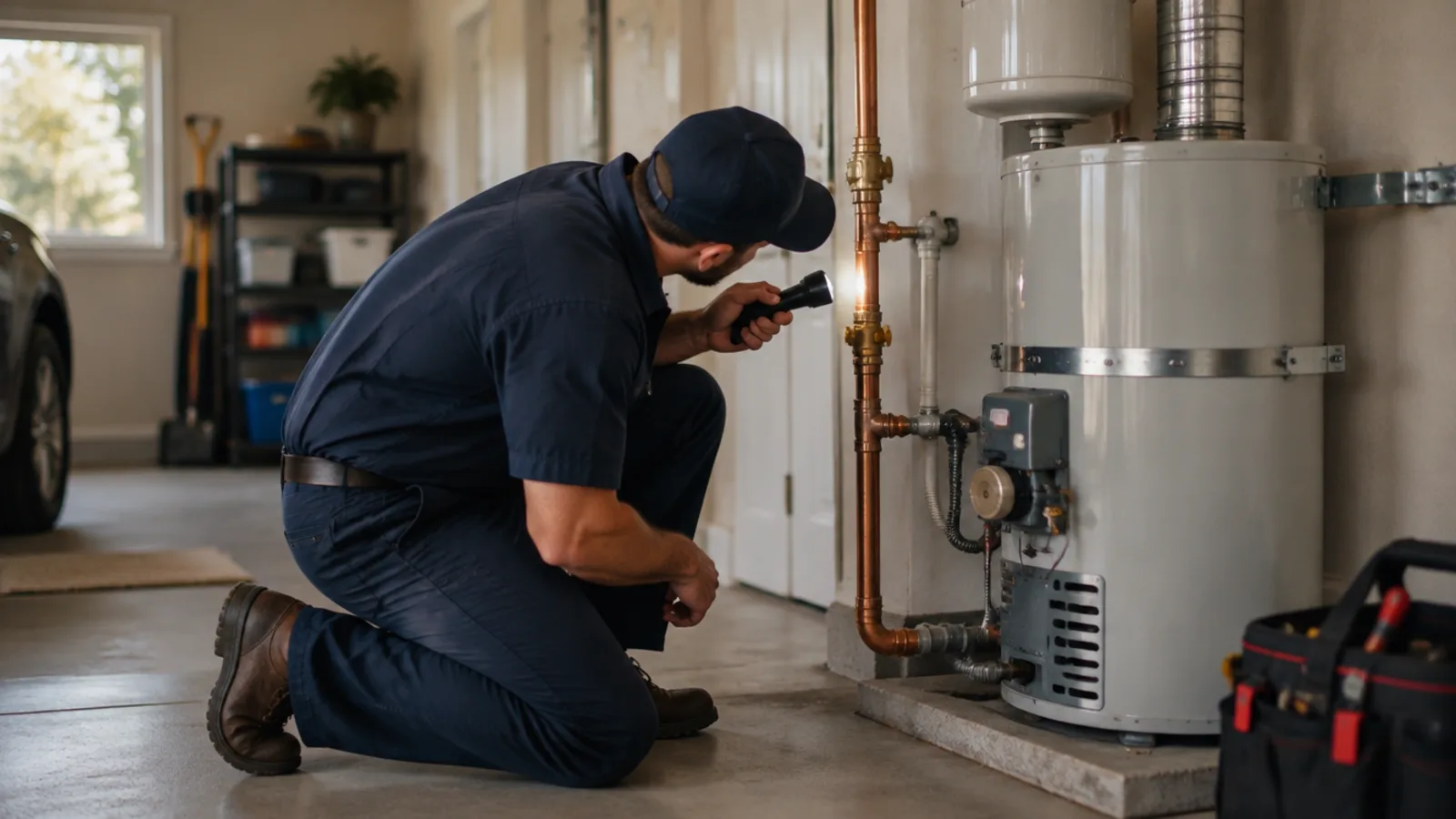
A water heater that has let go. Forty, fifty, sometimes eighty gallons on the floor with the cold supply still feeding it. In an interior closet over finished floor that is doing damage the whole time it runs.
No water at all in the house, when it is not the utility. A closed or failed main valve, a failed well pump, or a service line break. A household with no water is not a thing that waits comfortably.
The smell of gas anywhere near a gas water heater or a gas line. Leave, then call the gas utility from outside. Do not go hunting for it with anything that makes a spark.
Water near electrical — a panel, an outlet, a junction box. Shut the main off and leave the breakers alone unless the panel is dry and you can reach it standing on dry ground.
A leak you cannot isolate, anywhere. If closing the stop under the fixture does not stop it, the only valve left is the main, and a problem that needs the main closed is a problem you need somebody for.
If closing the valve at the fixture does not stop it, the only thing left to close is the main — and that is the line between an inconvenience and an emergency.
What can wait, and what to do meanwhile
A single slow or blocked drain, with the rest of the house working normally. That is a branch problem, it is not coming back up anywhere, and it keeps until business hours. Stop using that fixture.
A dripping tap or a running toilet. Annoying and it adds up on the bill, but it is going down the drain, not into the house. Close the stop valve behind the toilet if the fill will not stop.
One fixture that does not work — a toilet that will not flush, a shower with no hot, a disposal that hums. Nothing is escaping. Use another one.
No hot water, with no water on the floor. A thermostat, an element, a thermocouple or a breaker. Cold showers are not an emergency.
A small, slow leak you have been able to catch and isolate. A bucket under a trap and a closed stop valve buys you the night. Photograph it where it is, dated, before you mop anything up.
Low pressure at one fixture. Usually an aerator or a stop valve. Low pressure at every fixture at once is a different thing and worth a call.
One caution on all of these. Small and contained can change character. A weep at a fitting is a fitting until the fitting lets go. If what you are watching is getting worse hour by hour rather than staying the same, treat it as the first list.
Find your main shutoff before you need it
Go and find it now, while nothing is wrong, in daylight, with dry hands. Standing in two inches of water with a phone torch is the worst possible time to learn where it is.
On a Florida house there are usually two. The valve at the house is where the supply enters — most often on an exterior wall near the front or on the side closest to the street, sometimes in the garage, occasionally in a wall box. It is normally a ball valve with a lever or a gate valve with a round handle. The lever turns a quarter turn; the round handle turns clockwise and takes several full turns to close.
The other is at the street, in a meter box at ground level near the sidewalk or the property line. The lid is usually concrete or plastic and the box is often half full of sand and ants. The valve in there sits on the street side of the meter and takes a meter key — a long handled wrench. A crescent wrench will sometimes reach it. Keep a meter key where you can find it.
Turn the house valve off and on once a year. Valves that have never been moved seize, and a valve that will not close is the same as not having one. If yours will not turn, or weeps when you move it, that is worth replacing on a weekday rather than discovering on a Sunday.
Label it. A tag on the pipe saying what it is means anybody in the house — a teenager, a houseguest, a tenant — can close it without a tour.
While you are out there, find the gas shutoff at the meter if you have gas, and find the breaker for the water heater in the panel. Those two are part of the same drill.
The first ten minutes: burst line
Close the main. House valve if you can reach it, meter valve if you cannot. Quarter turn on a lever, clockwise and keep going on a round handle. This is the whole game and nothing else matters until it is done.
Kill the power to the water heater at the breaker, or the gas at the control knob. An electric heater that drains while the elements are energized burns them out, and a gas heater firing on an empty tank is its own problem.
Open the lowest taps in the house, inside and out. That drains the pressure and whatever is left in the pipes down through a sink or a hose bib instead of through the split.
Get the water moving away from what it can ruin. Towels, a shop vacuum, a push broom toward a door or a garage. Lift what you can off the floor — boxes, rugs, the bottom shelf of anything.
Photograph it before you clean it up, dated and from a few angles. The water, the wet floor, the split if you can see it, the ceiling if it came down from above. Then get fans on it. Whether any of it is covered is between you and your carrier, and we do not know what your policy says, but photographs taken before anybody touched it are worth having.
Then call. Tell us the main is off, where the water is, and whether it is on one floor or two. That is enough for us to know what we are coming to.
The first ten minutes: sewage backup
Stop running water everywhere in the house. No laundry, no dishwasher, no showers, no flushing. The line is blocked and every gallon you send down has nowhere to go but the floor. Tell everyone in the house, because this is the step people break without meaning to.
Keep people and pets out of it. That is sewage, not water. Shoes, gloves, and nothing touching it bare-handed.
Do not pour anything down there. Chemical drain openers do not touch roots or a bellied line, they sink and sit in the standing water they cannot get past, and they make the line dangerous for whoever opens it next. If you already poured something, say so when you call — it changes how the line gets opened.
Find the cleanout if you know where it is, and leave it alone. It is usually a capped pipe at ground level outside, often near a bathroom wall or a front corner. Knowing where it is saves us time. Opening it yourself with a blocked line behind it empties the line onto your yard and your shoes.
Photograph the backup before any of it gets cleaned up — the water, the floor, the affected rooms. Then move what is salvageable out of the way and stop.
Call and give us the history. How many times this has happened and roughly when. A line that has backed up before is a different conversation from one that never has, and the dates are the most useful thing you can hand us.